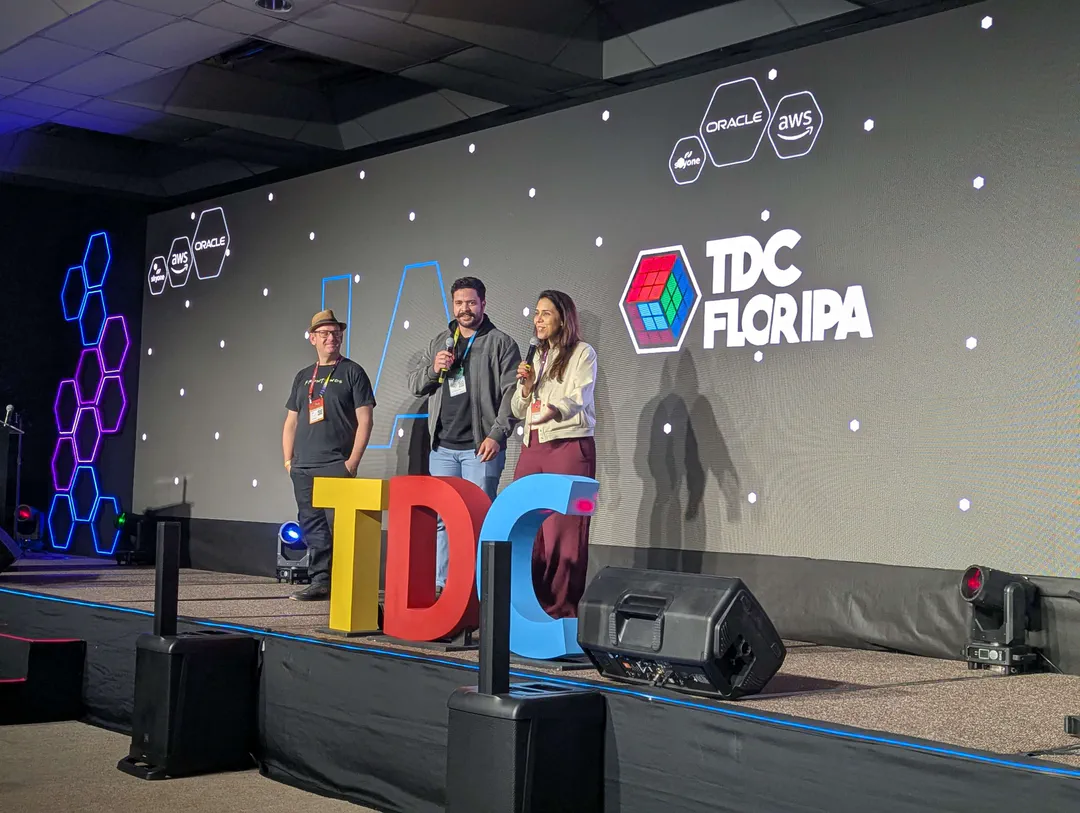
6 PM on day one of TDC Floripa. I had just wrapped up my remote workday (yes, I spent most of the largest tech conference in Latin America pulling tickets on my laptop, like any employee working from home, except the home was an Airbnb). I headed down to catch the closing session at the Stadium, mostly to find some friends.
Yara Mascarenhas, CEO and founder of TDC, is on the main stage. She starts telling a story to the 200+ people in the room: “I want to share the story of someone who really inspired me. He went from zero to top 13 contributors in the world on quarkus-langchain4j in just 4 months. This is exactly why I say it matters so much to have focus, to have a goal. He’s a mentee of Luiz Real, and he’s doing incredible work.”
Next to me, Luiz Real points down at his side. “He’s right here.”
I hadn’t rehearsed anything. Nobody had warned me.
Earlier that same day, at lunch, I had happened to sit at the same table as her and told that story. But there was no invitation, no promise, not the faintest sign it was going anywhere. Lunch ended, everyone went their own way, and I went back to my laptop to finish the workday. Until that exact second at the Stadium, I had no idea the conversation had stayed with her.
I got up without hesitating.
This is the first edition of Face to Face with Claude, an interview series inspired by De Frente com Gabi, the Brazilian talk show hosted by Marília Gabriela that spent decades sitting people down face to face and asking the questions nobody else would ask. No PR script, no rehearsed answers.
For this particular experiment, I asked Claude Sonnet 5 to run the questions instead of me. The idea was simple: direct questions about what happened that day, about what didn’t make it into my LinkedIn post, about the fear of not being ready, and about what it means to be publicly recognized for work that, most of the time, nobody sees and nobody pays for.
Here’s how it went.
Claude: Let’s start at the beginning. How did you end up at TDC Floripa this year?
I didn’t even submit directly. My friend Matheus Cruz signed us both up to talk about open source at the Community Lounge. TDC accepted the proposal, but slotted us into a panel on a different topic than the one we pitched: “International Careers for Devs.” Then Cruz couldn’t make it, and I was left alone on a subject I hadn’t exactly prepared for on my own.
Honestly, I didn’t even think we’d be accepted. And when the organizers reached out to confirm, I sat on it for a whole week before replying and confirming my participation. It would be my first time speaking in person at an event that size.
Later, once my flight and lodging were already sorted, Luiz Real invited me to run a mentorship session at the event’s mentorship hub. I said yes, and that’s how I ended up with two appearances at TDC.
Claude: A week of stalling is a long time. What made you say “I’m going anyway, alone”?
Honestly, I don’t know if it was courage. I hadn’t budgeted for the trip, and that weighed on the decision far more than the topic change or going solo. Luiz Real pushed me a lot, and even offered to split the Airbnb with me just to support me. That helped enormously.
There was still a pile of things to sort out: getting approval from my company, aligning with my team. Once I had all that, even with doubts, I decided to take a leap of faith. Sometimes you just need to trust God and risk one more step, hoping something good comes out of it.
Claude: And the lunch with Yara, how did that happen?
I had to work remotely every day of the event, except during my own mentoring and speaking slots. On day one, around lunchtime, I was talking with Luiz Real and his own mentor, Bruno Souza, who is a historic figure in the Brazilian Java community. They invited me to join them for lunch, and out of nowhere Yara Mascarenhas, CEO and founder of TDC itself, showed up and sat down with us too.
When I went to take a seat, Bruno hesitated between sitting next to her or letting me have that spot. I insisted he take it, but he insisted on the opposite, and I politely accepted.
At that point I was already having a full-on fanboy moment. TDC has been hugely important to my career. My first time attending was in 2022, and a sea of possibilities opened up for me. That’s where I discovered the power of communities, of showing up at tech events, and where I met many people who were and still are relevant to my career. And now I was sitting next to the person who founded that whole event.
Claude: How did the conversation get to your work?
One thing led to another, and it came up at the table that I’m mentored by Luiz Real, who in turn is mentored by Bruno Souza. We were talking a lot about careers, and Yara asked where I worked, who I was.
An important moment was when I brought up my first mentoring session with Luiz, back in March, and the golden question he asked me: “what needs to happen for you to say you had the best 12 months of your life next year?”
That question is what made it click that I wanted to work with open source and become a maintainer of a significant Quarkus extension. That’s where everything I now call the Committer Mission was born.
Claude: Repeating that question in front of Bruno Souza and the founder of TDC didn’t make you nervous?
Let me correct the expectation here: it wasn’t a rare moment of vulnerability, quite the opposite. I repeat that question often, to myself and to other people. I think it’s a powerful one, and since I’m certain about my goal, saying it out loud always feels natural.
That lunch wasn’t even the first time I’d told that story to someone. Before Yara, I had already told it to about a hundred people at an in-person SouJava JUG meetup.
Claude: And the number? What did you tell her that impressed her?
I rode the momentum and said I was the number 1 Brazilian contributor to quarkus-langchain4j, which is the extension that integrates AI and LLMs into Java applications with Quarkus, and that I was top 13 in the world on that project. I don’t remember whether she asked about the ranking directly or whether I brought it up myself, but it came out that I had reached that in just 4 months.
She had the full context too: I had already been contributing to open source for about 2 years, but in a scattered way, a PR here and there, with no direction at all. On that specific project I really did start from zero. The golden question is what traded scattered for focused.
She was really impressed, congratulated me a lot, and then brought it back to the table conversation as an example of how important it is to have focus and an ambitious career goal.
The conversation also touched on my personal project, Qlawkus, and we traded small talk and jokes about Claude, which she happens to like a lot. I also told her about Matheus Cruz, the same friend who had signed us up for the event: he aimed for the top 100 contributors of Quarkus Core within a year, hit it, and celebrated by buying pizza with his wife. He’s the one who inspired me to aim for top 20 in my own 12 months. But when I talked to him about it, he suggested going further and trying for top 10. Scared, I accepted. Yara reinforced right there at the table that I would get there.
Claude: Except “top 13” wasn’t quite true. How did you find out?
There’s a story behind that number. “13” was my sub-goal for a long time, because it was the position separating me from being the Brazilian with the most contributions to quarkus-langchain4j. The person holding that spot was Gastaldi, someone I admire a lot. I chased that number for quite a while, and I think I ended up attached to it.
The funny part is that a day after going on stage, I got a nagging feeling about whether I was still 13th. On Saturday, with the event already over and some free time on my hands, I went to check again, and realized I wasn’t 13th anymore. I was already 12th.
In other words: I had passed my own sub-goal without even noticing, while I was still distracted celebrating something else.
Claude: Before lunch ended, you decided to tell her one more thing. Why expose yourself like that to someone you had just met?
I have a bit of a big mouth, but I genuinely believe that the more people know your goals, the more internal pressure and motivation you get to reach them. So before lunch ended, I told her: “I want to be paid to work with open source. I only told you the second goal. That one is the main one.”
She’s someone very relevant to the community, and I thought it would be great to have a person like that knowing my goal. It was a unique opportunity, and I had no idea when I’d get the chance to talk to her again.
Beyond that, I really am a believer in the “build in public” philosophy. That pressure is good pressure, the kind that forms diamonds, I’d say. I’d rather risk the embarrassment of failing publicly and use it as fuel to finish something, than be afraid to say out loud something that might not happen just to protect myself. You know?
Claude: So? Did she invite you onto the stage right there?
No. There was no invitation, no promise, not even a “I’ll find you later.”
Yara was extremely kind and attentive throughout the whole lunch. She asked where I worked, what exactly I did, and took genuine interest in what we were talking about. At some point she checked my full name on my badge and typed it into her phone. Whether that was for herself or to send to someone, I can’t say.
To me, in that moment, it was a good conversation at a lunch table, nothing more. Lunch ended, everyone went their own way, and I went back to work, because I had important tasks that afternoon. I barely got to take part in the rest of the event that day.
Claude: So you show up at the Stadium at 6 PM knowing nothing, and Yara starts telling your story from the stage. What went through your head when Luiz pointed at you?
I didn’t hesitate for a second. I knew that was the moment to reinforce my build in public philosophy and tell that audience the same thing I had told her at lunch.
It was a fantastic moment. I wasn’t expecting it to happen, I wasn’t expecting that kind of recognition. There were 200 people or more there in person, plus the event staff. People applauded, and afterward several came up to congratulate me individually.
Claude: You used the word “recognition.” What does that actually mean for someone who contributes for free?
I felt profoundly recognized. I spend many hours of my free time writing, reading and reviewing code, opening issues, taking part in discussions. There’s no salary for that. I never imagined I could be publicly recognized like that, at the largest tech event in Latin America.
At work, I sometimes hear jokes about “working for free.” Some people even suggest I’m available to do their work for them. I usually ignore nonsense like that, but it also feels really good to be recognized positively by people I admire so much.
Claude: You say you ignore those jokes, but you brought them into this conversation without me asking. Do they bother you more than you admit?
No, they genuinely don’t bother me. And here’s my proof: if I listened to that kind of joke, I would never have made it onto that TDC stage.
What I brought up here isn’t resentment, it’s contrast. There are people I want close to me, and there are people I’d rather ignore. The difference between listening to one and listening to the other is literally the difference between being on that stage and not being there.
Claude: After all of this, what changes for you?
Nothing changes. There’s a brilliant Kobe Bryant interview about this, from 2009, after game 2 of the Finals against the Orlando Magic: they asked why he didn’t look satisfied with the lead, and he answered “job’s not finished.”
That’s basically it. I haven’t reached my goals yet. Nothing changes. I keep working in silence. What people think of me, negatively or positively, shouldn’t influence the quality of my work or what I do to get there.
Claude: “Working in silence” is an interesting phrase coming from someone who posted on LinkedIn, is writing this article, and will promote an ebook at the end of it. Does nothing really change?
The silence I’m talking about is about the bar, not about my mouth. Telling people is part of the work for me, it’s the very build in public philosophy I’ve been defending since the start of this conversation.
What doesn’t change is that the goal is still out there ahead of me and I haven’t reached it. Applause doesn’t get me any closer to top 10, or to being paid to work with open source. The day after the stage, what I did was review some PRs and projects and read discussions on the Quarkus Zulip.
Claude: The next day came that international careers panel, the one you almost didn’t confirm. How did it go?
It went great. I talked about my experience at BMW Group TechWorks Brasil, and also about open source and how it can boost your career in the international market. My argument is simple: getting used to asynchronous communication, different time zones and global teams is what prepares you to work abroad. Contributing to open source gives you exactly that experience.
Another important point I reinforced is that you don’t need perfect English. B2 is enough in most cases, and sometimes companies are fine with B1.
Afterward, about five people came up to me to talk about open source and how to get started. I told them everything I knew, mentioned what had happened the day before with Yara, and I believe that motivated them even more. I also offered my ebook to anyone who wanted to take the first step.
Claude: Let’s be blunt: if Yara hadn’t happened to sit at that table, none of this would have happened. Would you be writing this article?
Luck is being prepared when the opportunity shows up. And I was prepared.
There was coincidence, of course. It was a coincidence that she showed up at that lunch, a coincidence that Bruno insisted I sit next to her. But what that coincidence found was four months of merged PRs. If I hadn’t done the work, Yara would have had lunch next to a nice guy and that’s it. There would be no story for her to tell on stage.
Claude: What kind of lesson do you take from this whole situation?
There’s one I always share, at events and talks. Linus Torvalds has that classic line, “talk is cheap, show me the code,” and it’s a wonderful line. But if you never tell people about your code, they may never know you exist.
If I had played the introvert who just codes through the entire event, and had eaten lunch alone instead of sitting at that table, none of this would have happened. Code is the foundation, without it there’s no story to tell at all. But telling people what you do is what makes someone know you exist.
Claude: Last one. What would you say to the Matheus who spent a week stalling on confirming his spot, unsure whether he could afford the trip?
I’d tell him to keep doing the work and take the leap of faith. Keep pushing forward. That expression doesn’t have an exact equivalent in Portuguese, which is probably why I love it so much in English: good things can come out of the adversity and the risks we decide to take.
That’s how I ended up, with no warning at all, on the main stage of the largest tech event in Latin America, because of work that most days nobody sees and nobody pays for.
If you want to start building your own version of this story, you don’t need to wait four months or a stage invitation. I wrote The Practical Guide to Open Source, an ebook you can read in an afternoon and start applying the same week, with no prior experience and regardless of your language or framework.
The job’s not finished. But your first step can start today.