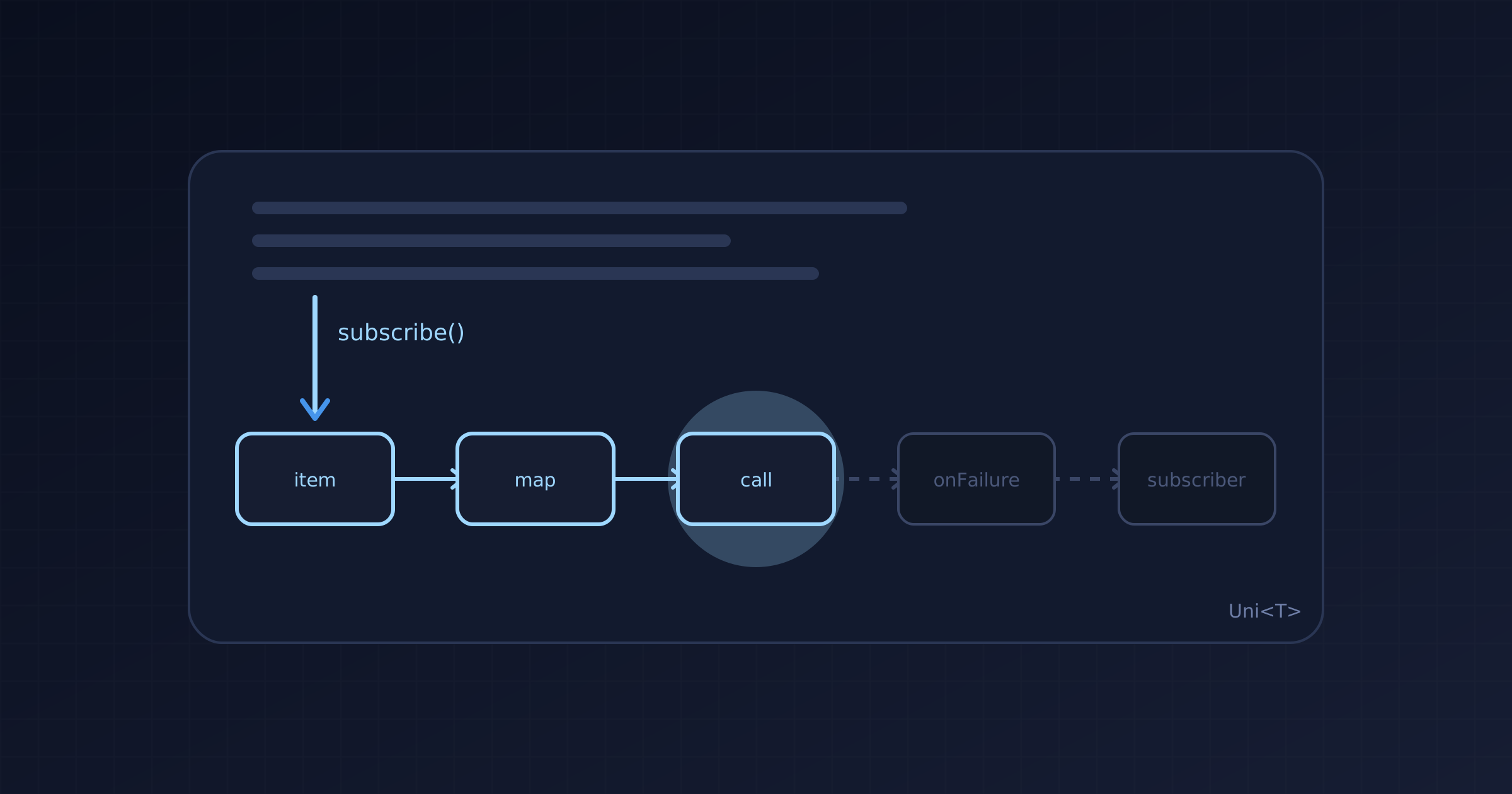
This method places an order after writing it to an audit log. The audit is asynchronous, so it returns a Uni<Void>:
public Uni<String> place(String order) {
    return Uni.createFrom().item(order)
            .invoke(audit::apply)
            .map(placed -> "placed:" + placed);
}
It compiles. It runs. It returns placed:order-42. And the audit log stays empty:
expected: <[order-42]> but was: <[]>
Nothing failed, nothing was logged, and the bug would reach production unnoticed. To see why, you need one idea that the rest of Mutiny follows from: a Uni is a recipe, not a result.
Part 1 of this series went below Quarkus, to the event loop. Part 2 showed how Quarkus picks the thread where your method starts. This part is about what happens after it starts, when the method returns a Uni or a Multi.
The lab
The tests in this article live in labs/mutiny of the demo: plain JUnit, Mutiny 3.3.0, no Quarkus, so they run in seconds. Each behaviour is driven by a small production class, and each test was first run against a naive version of that class. The red messages are kept in the module’s README, because they explain the behaviour better than prose. Two tests come from the REST Client module, where timeouts need a real slow server. Quarkus 3.40.1 and 4.0.0.Beta1 both ship Mutiny 3.3.0, and every test here passes on both.
1. Nothing happens until someone subscribes
The Mutiny documentation says it plainly:
If no subscriber subscribes, no items will be emitted. More importantly, nothing will ever happen.
ExchangeRates wraps a remote call in a Uni. The tests count how many times the remote service is called:
public Uni<String> rate() {
    return Uni.createFrom().item(fetchRate);
}
@Test
void buildingAUniCallsNothing() {
    Uni<String> rate = rates.rate();

    assertEquals(0, remoteCalls.get());
}

@Test
void eachSubscriptionCallsTheRemoteServiceAgain() {
    Uni<String> rate = rates.rate();

    assertEquals("5.41", rate.await().atMost(TIMEOUT));
    assertEquals("5.42", rate.await().atMost(TIMEOUT));
    assertEquals(2, remoteCalls.get());
}
Building the Uni calls nothing. Subscribing calls the service, and subscribing again calls it again. That is the difference from a CompletableFuture, which represents work that has already started. A Uni describes work that has not.
Two details turn this into bugs. The first is the argument you pass:
public Uni<String> rateFetchedRightAway() {
    return Uni.createFrom().item(fetchRate.get());
}
With a value instead of a supplier, the call runs while the Uni is built, before anyone subscribes, and the test sees one remote call with no subscription at all. item(supplier) and item(value) look almost the same and behave in opposite ways.
The second is when you want a result instead of a recipe. memoize() does that: the first subscription runs the call, and every later one gets the same item.
this.shared = rate().memoize().indefinitely();
Two subscriptions, one remote call. Use it on purpose: from then on, every subscriber gets that first result, however old it is.
2. Who subscribes in Quarkus
If nothing happens without a subscription, who subscribes in a Quarkus application? Clement Escoffier answered it in a post about retries:
In Quarkus, most of the time, you return the Uni, and Quarkus subscribes to it. So, don’t be mistaken, there is a subscription, you may not see it.
Quarkus REST subscribes to the Uni your endpoint returns. Reactive Messaging subscribes to the Uni your consumer returns. A Uni that you build and do not return, or do not chain into the one you return, is never subscribed. That is the opening bug.
invoke is for synchronous side effects. Its callback returns nothing, so when you pass audit::apply, a method that returns a Uni<Void>, Java accepts it as a Consumer and throws the returned Uni away. Nobody subscribes to it, so the audit never runs. The operator for an asynchronous side effect is call:
public Uni<String> place(String order) {
    return Uni.createFrom().item(order)
            .call(audit::apply)
            .map(placed -> "placed:" + placed);
}
Escoffier’s post on the two operators describes the difference precisely. For invoke, “Mutiny invokes the callback and propagates the event downstream when the callback returns. It blocks the dispatching.” For call, “Mutiny does not dispatch the original event downstream until the Uni returned by the callback emits an item”.
invoke | call | |
|---|---|---|
| Callback returns | nothing | a Uni |
| Subscribes to what the callback returns | no | yes, and waits for its item |
| Use it for | logging, a quick synchronous side effect | an asynchronous side effect: audit, flush, close |
sequenceDiagram
    participant Q as Quarkus
    participant P as place()
    participant A as audit Uni
    Note over Q,A: with invoke(audit::apply)
    Q->>P: subscribe
    P->>A: builds it and drops it
    P-->>Q: placed:order-42
    Note over A: no subscriber, the audit never runs
    Note over Q,A: with call(audit::apply)
    Q->>P: subscribe
    P->>A: subscribe
    A-->>P: item, the audit is written
    P-->>Q: placed:order-42
The same mistake shows up with Hibernate Reactive: repository.persist(entity) returns a Uni, and calling it on its own line, without chaining it into the Uni you return, leaves that Uni with no subscriber. The rule is always the same: every Uni has to end up in the chain that somebody subscribes to.
3. Retry is resubscription
Laziness is not only a trap. It is what makes retry possible. You cannot rerun a CompletableFuture that has already finished, but you can follow a recipe again. Escoffier again:
It resubscribes until it gets a successful response. In other words, retrying is resubscribing.
RetryingCall wraps onFailure().retry().atMost(2), and the test counts subscriptions to a flaky source that fails twice:
String result = retrying.call(flaky).await().atMost(Duration.ofSeconds(5));

assertEquals("ok", result);
assertEquals(3, subscriptions.get());
Three subscriptions: the first attempt and two retries. When every attempt fails, the caller gets the last failure, failure-3. And since each retry runs the whole upstream again, the same post has the warning that matters more than the API: “you can only retry if your system is idempotent”. withBackOff, withJitter and expireIn control when to retry; none of them makes a non-idempotent call safe to repeat.
4. Mutiny schedules nothing
Part 2 was about which thread starts your method. Inside a pipeline, the Mutiny documentation sets the rule:
Except indicated otherwise, Mutiny invokes the next stage using the thread emitting the event from upstream.
and, on the page about pitfalls, the stronger version:
Mutiny itself does not perform any scheduling work, except for the
emitOnandrunSubscriptionOnoperators.
BlockingLookup wraps a blocking call in a Uni. Without any operator, the call runs on the thread that subscribes, which in the test is the test’s own thread. In Quarkus, that would be the event loop if the endpoint returns the Uni. Wrapping blocking code in a Uni does not make it non-blocking; it only delays it until the subscription.
The two operators that move work do it in opposite directions:
| Operator | Moves | Typical use |
|---|---|---|
runSubscriptionOn(executor) | the subscription, so the work done when subscribing, such as a blocking call | a blocking source |
emitOn(executor) | every event that follows: items, failure, completion | processing each item somewhere else |
The tests confirm both: with runSubscriptionOn, the blocking call runs on lookup-worker; with emitOn, every stage after it runs on processor-worker. The documentation adds a warning worth repeating: emitOn “can lead to concurrency problems with non thread-safe objects such as CDI request-scoped beans”. In Quarkus, the default executor of Mutiny is the worker pool, and as part 1 showed, await() refuses to run on an event loop.
flowchart LR
    S["subscribe()"] --> R["runSubscriptionOn: the source runs here"]
    R --> A["stage"]
    A --> E["emitOn: everything below runs here"]
    E --> B["stage"]
    B --> C["subscriber"]
5. combine does not run anything in parallel
QuoteAggregator joins two quotes with Uni.combine().all().unis(first, second). It looks like a parallel call. The pitfalls page says otherwise:
You might think that the
joinoperator schedules the calls tofetchto be run concurrently, and then collects the results into a list. This is not how it works!
The test records a timeline with two synchronous sources:
assertEquals(List.of("a:start", "a:end", "b:start", "b:end"), timeline);
combine subscribes to the first source, which runs to the end on the subscribing thread, and only then subscribes to the second. The sources only overlap when they are asynchronous, which is what the second test shows: each source runs on its own thread and waits until the other has started. A naive version that chained the two sources with chain failed that test with expected: <[a, b]> but was: <[a:ran-alone, b]>: the first source waited a second for the second, which only started after it.
In a real Quarkus application, the overlap comes from the source, not from combine. In the REST Client module, the reactive endpoint combines two calls to a slow upstream. The calls overlap because the reactive REST Client does not hold a thread while it waits for a response: subscribing to the first Uni sends the request and returns, and the second request goes out right after.
return Uni.combine().all()
        .unis(upstream.quoteAsync(), upstream.quoteAsync())
        .with((first, second) -> List.of(first, second))
        .ifNoItem().after(TIMEOUT).fail()
        .map(Observed::of);
The same pitfalls page has a related warning: a Uni or Multi whose initial source does no I/O and already has its data in memory “is suspicious”. It is fine in a test and a warning sign in production.
On a Multi, the same question is about order. transformToUniAndConcatenate waits for each call and keeps the input order; transformToUniAndMerge runs them concurrently and emits in completion order. With calls that take longer for smaller numbers, the first returns [1, 2, 3] and the second [3, 2, 1].
6. A failure ends the stream
In Mutiny, a failure is an event, like an item. It is also a terminal event. Escoffier’s post on failure handling says “Failures are terminal events. If your upstream propagates a failure, it means it can’t operate normally”, and the consequence surprises people on a Multi:
List<Integer> items = stream.recoverAtTheEnd(Multi.createFrom().range(0, 10), REJECT_SEVEN, FALLBACK)
        .collect().asList().await().atMost(Duration.ofSeconds(5));

assertEquals(List.of(0, 1, 2, 3, 4, 5, 6, FALLBACK), items);
The mapper rejects 7, recoverWithItem emits the fallback, and the stream ends. Items 8 and 9 never arrive, because the stage that failed cancelled its upstream. Recovering does not bring the stream back.
The fix is to give each item its own Uni, so the failure and the recovery stay inside it:
return items.onItem().transformToUniAndConcatenate(item -> Uni.createFrom().item(() -> mapper.apply(item))
        .onFailure().recoverWithItem(fallback));
Now the result is [0, 1, 2, 3, 4, 5, 6, FALLBACK, 8, 9]. This is also why a Kafka consumer built on a single Multi can stop consuming after one bad message.
7. Demand flows upstream
Items flow down a Multi; requests and cancellations flow up. The Mutiny documentation calls the request “the cornerstone of the back-pressure protocol”, and three tests show what it buys.
A source that respects demand produces only what was asked for. Sensors is an endless stream built with Multi.createFrom().generator(...). The test requests three readings and cancels:
AssertMulti.create(sensors.readings())
        .withInitialRequest(0)
        .thenRequest(3)
        .expectNext(1, 2, 3)
        .thenCancel()
        .verify();

assertEquals(3, produced.get());
The naive version used an emitter that ignored demand and failed with expected: <3> but was: <100>.
Cancellation travels to the source. PageFetcher turns a paginated API into a stream of items, the way Escoffier’s pagination post does: it repeats a page call until a page comes back empty.
return Multi.createBy().repeating()
        .uni(AtomicInteger::new, page -> loadPage.apply(page.incrementAndGet()))
        .until(List::isEmpty)
        .onItem().disjoint();
With pages of two items and a consumer that takes the first three with select().first(3), the test asserts that exactly two pages were loaded. When first(3) has enough, it cancels, the cancellation reaches the repetition, and no other page is requested. The imperative loop would need a counter and a break to do the same.
sequenceDiagram
    participant S as Subscriber
    participant F as select().first(3)
    participant R as Page repetition
    S->>F: request
    F->>R: request
    R-->>F: page 1: items 1 and 2
    R-->>F: page 2: items 3 and 4
    F-->>S: 1, 2, 3
    F->>R: cancel
    Note over R: page 3 is never loaded
A source that cannot slow down needs a decision. Ticks, user input and sensors on a push protocol do not wait for requests. For them, Mutiny has onOverflow(). BurstBuffer uses a bounded buffer, and the test shows what happens when it fills up: the subscriber gets a BackPressureFailure instead of a heap that keeps growing. Escoffier’s view of the alternative, an unbounded buffer: “In general, that’s a terrible idea as you may run out of memory.”
Not every source should be a Multi. The pitfalls page makes the point that databases do not stream: a SQL query returns all its rows, and the protocol has no back-pressure, so Uni<List<Row>> describes it more honestly than Multi<Row>.
8. Time is an event too, and there are two TimeoutExceptions
A recipe can also wait forever, so every model in the demo bounds its wait. The REST Client module has an upstream that takes two seconds and a one-second budget, and TimeoutTest expects a 504 from each variant:
| Variant | Mechanism |
|---|---|
| worker | the REST Client read timeout |
| reactive | ifNoItem().after(TIMEOUT).fail() |
| virtual thread | await().atMost(TIMEOUT) |
ifNoItem() treats the absence of an item as an event you can react to: fail, recover with a fallback or switch to another Uni.
Writing this test turned up a trap. In the reactive variant, two timeouts race: Mutiny’s ifNoItem and the REST Client read timeout. Which one wins depends on configuration, so ClientTimeoutFirstTest shortens the read timeout to make the client win every time. The failure that reaches the endpoint is then not Mutiny’s:
| Class | Extends | Raised by |
|---|---|---|
io.smallrye.mutiny.TimeoutException | RuntimeException | ifNoItem().fail(), await().atMost() |
io.vertx.core.impl.NoStackTraceTimeoutException | java.util.concurrent.TimeoutException, a checked exception | the reactive REST Client |
An exception mapper declared for RuntimeException never sees the second one. The demo’s mappers take Exception and search the cause chain for any timeout, which is how the test gets its 504. The hierarchy is the same in Vert.x 4.5.34 and 5.1.8. If your mapper or fault tolerance policy catches RuntimeException to handle timeouts from the reactive client, test it with a timeout the client raises itself.
9. What changed since 2020
Most of what is written about Mutiny online comes from 2020, including Escoffier’s excellent series on the Quarkus blog. The ideas hold; some of the API does not. I checked every call against the Mutiny 3.3.0 sources:
| 2020 | Mutiny 3.3.0 |
|---|---|
collectItems().asList() | collect().asList() |
transform().byFilteringItemsWith(p) | select().where(p) |
transform().byTakingFirstItems(n) | select().first(n) |
onSubscribe().invoke(...) | onSubscription().invoke(...) |
onOverflow().drop(x -> log(x)) | onOverflow().invoke(x -> log(x)).drop() |
org.reactivestreams.Subscriber | java.util.concurrent.Flow.Subscriber |
Almost all of it changed in Mutiny 2, which moved to java.util.concurrent.Flow. Mutiny 3.0 had only two changes marked as breaking: Uni.join().all() accepts an empty list, and onFailure(RuntimeException.class) became typed. Failure handling, retries, combine, transformToUniAndMerge and the pagination pattern are unchanged.
Conclusion
A Uni is a description of work. Building it does nothing; subscribing runs it, and every subscription runs it again. That one idea explains the audit that never ran (nobody subscribed to the Uni that invoke dropped), retry (a new subscription), the call that ran too early (item(value) instead of a supplier) and memoize (turning the recipe into a result).
Mutiny does not decide threads either. A stage runs on the thread that emitted the event, combine and merge only overlap work that is already asynchronous, and only emitOn and runSubscriptionOn move anything. When the work does flow, demand flows back: sources produce what was requested, cancellation stops them, and failures end a stream unless you contain them per item.
With that, the series has covered the three ways Quarkus runs your code: on an event loop, on a worker and on a virtual thread. Part 4 puts them side by side under load, with the Quarkus 4 stack underneath: which one to pick, and what limits each of them, which is rarely the model itself.
Resources
- Demo:
quarkus/reactive-core:labs/mutiny(every package) andintegrations/rest-client(TimeoutTest,ClientTimeoutFirstTest) - Mutiny documentation: What makes Mutiny different, emitOn vs runSubscriptionOn, Going reactive: a few pitfalls, Controlling the demand
- Clement Escoffier on the Quarkus blog (2020): failure handling, pagination, concurrent calls, retry, back-pressure, invoke and call
- Mutiny primer in Quarkus
- Previously in this series: part 1, the event loop from the ground up and part 2, who runs your code